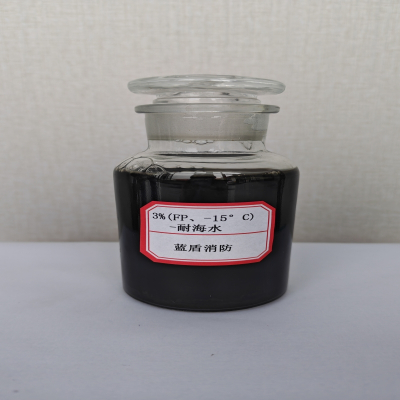
What Is Seawater Resistant AR AFFF Concentrate?
Fire protection in marine, offshore, and industrial environments presents unique challenges. Limited freshwater availability, high temperatures, and complex fuel types all demand a fire suppression solution. The solution must be powerful. It must be adaptable. Seawater Resistant AR AFFF Concentrate has emerged as a trusted foam firefighting agent. It is designed precisely for these demanding conditions.
This in-depth guide explains what Seawater Resistant AR AFFF Concentrate is. It explains how it works. It explains where it is used. It explains why it is considered a high-performance and environmentally responsible firefighting solution.
1. Understanding Seawater Resistant AR AFFF Concentrate
1.1 Definition and Core Concept
Seawater Resistant AR AFFF Concentrate is a specialized foam firefighting agent. It is classified as an Alcohol-Resistant Aqueous Film-Forming Foam (AR AFFF). It is specifically formulated to maintain its extinguishing performance. It can be mixed with either freshwater or seawater. This makes it ideal for marine and coastal operations.
Conventional foam agents may lose stability or expansion performance in saline environments. This concentrate is engineered to remain effective. It works even under harsh conditions. These conditions include saltwater, high heat, and aggressive fuels.
1.2 Advanced Chemical Composition
The high efficiency of Seawater Resistant AR AFFF Concentrate comes from its advanced formulation. The formulation includes:
Hydrocarbon surfactants
Fluorocarbon surfactants
Anti-drying agents
Performance-enhancing additives
Polar solvent film-forming agents
Stabilizers
Antifreeze components
Corrosion inhibitors
This carefully balanced formula ensures excellent surface activity. It ensures high thermal stability. It ensures strong wetting ability. It ensures superior flow characteristics. The foam produced by Seawater Resistant AFFF Concentrate exhibits high density. It has strong adhesion. It provides long-lasting coverage over burning surfaces.
1.3 Why Seawater Resistance Matters
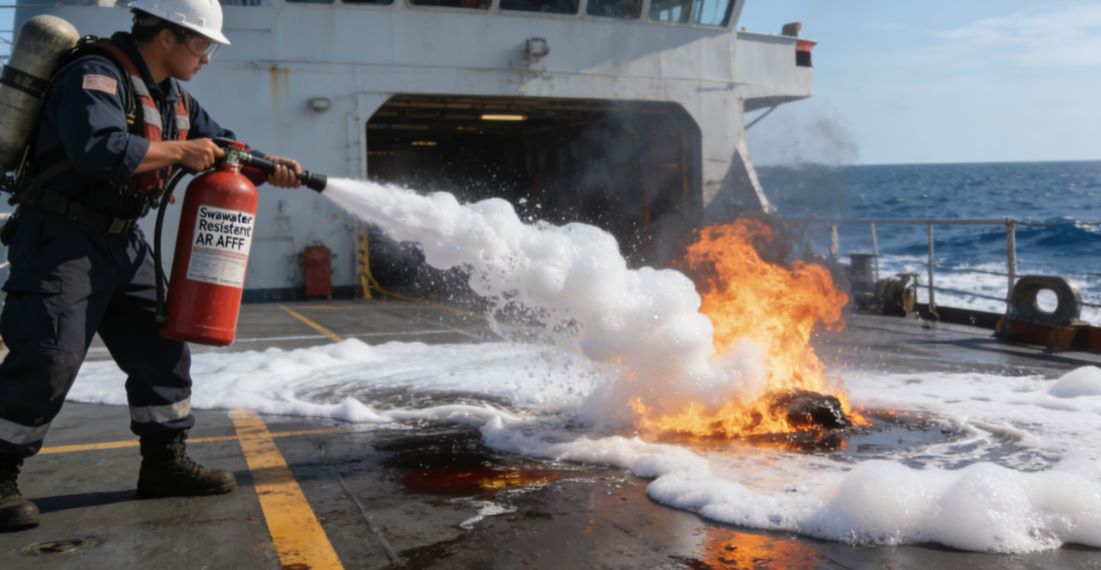
In many real-world fire scenarios—especially on ships, offshore platforms, oil terminals, and coastal chemical plants—freshwater is either limited or unavailable. Seawater Resistant AR AFFF Concentrate solves this problem. It allows direct mixing with seawater. It does not compromise foam quality.
This capability reduces operational costs. It ensures faster response times during emergencies. Every second counts in emergencies.
2. Performance Advantages and Firefighting Mechanism
2.1 How Seawater Resistant AR AFFF Concentrate Works
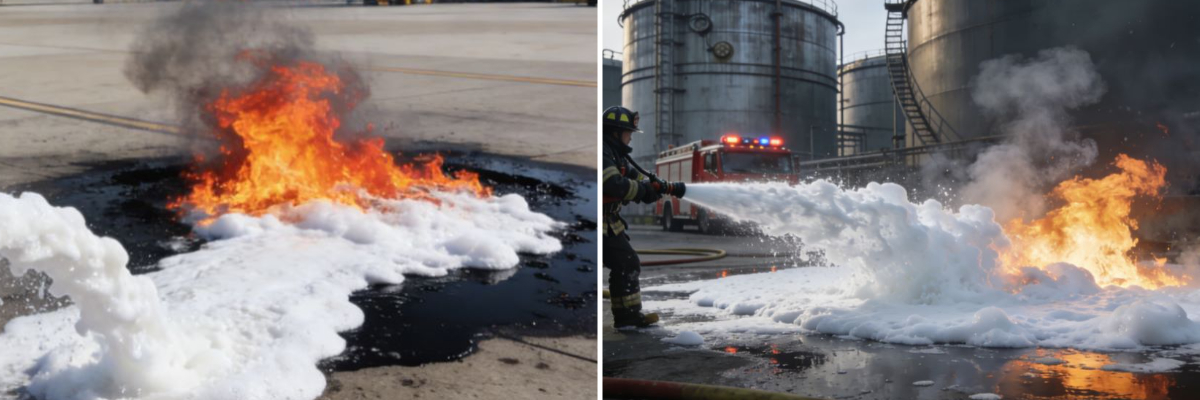
When deployed, Seawater Resistant AR AFFF Concentrate forms a stable foam blanket. The blanket spreads rapidly across the burning liquid surface. At the same time, it creates an aqueous film. The film suppresses fuel vapor release.
For polar solvent fires, a protective polymer membrane forms. It forms between the foam and the fuel. It prevents the foam from being destroyed by water-miscible liquids. These liquids include alcohols and ketones.
This dual-action mechanism enables Seawater Resistant AFFF Concentrate to control fires. It suppresses fires. It extinguishes fires efficiently. It prevents re-ignition.
2.2 Key Firefighting Benefits
The foam generated by Seawater Resistant AR AFFF Concentrate offers multiple performance advantages:
High foam density for rapid knockdown
Strong adhesion to vertical and irregular surfaces
Long drainage time for sustained fire suppression
Excellent heat insulation and radiant heat resistance
Effective re-ignition prevention
These properties significantly improve firefighting efficiency and safety. This is particularly true in high-temperature environments. These environments involve flammable and combustible liquids.
2.3 Environmentally Responsible and Equipment-Safe
The product has powerful performance. Seawater Resistant AR AFFF Concentrate is designed to be environmentally cleaner. It is cleaner compared to traditional foam agents. It is:
Free from unpleasant odors
Non-corrosive to firefighting equipment
Safe for foam proportioning and discharge systems
This makes Seawater Resistant AFFF Concentrate suitable for long-term storage. It is suitable for repeated use in fixed or mobile firefighting installations.
3. Application Scenarios and Industry Use
3.1 Suitable Fire Types
Seawater Resistant AR AFFF Concentrate is suitable for extinguishing:
Hydrocarbon fuel fires (oil, gasoline, diesel, jet fuel)
Water-soluble flammable liquid fires such as:
Alcohols
Esters
Ethers
Aldehydes
Ketones
Amines
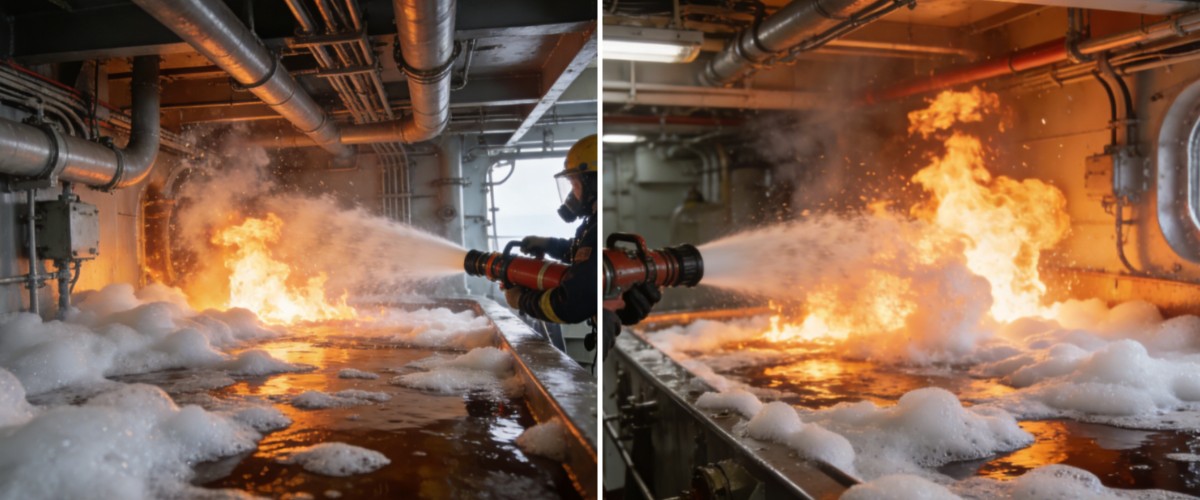
It can be applied on the surface. It is also effective for subsurface injection firefighting. This is particularly true in storage tanks and fuel containment systems.
3.2 Typical Application Environments
Thanks to its versatility, Seawater Resistant AFFF Concentrate is widely used in:
Petrochemical plants
Chemical manufacturing facilities
Synthetic fiber and solvent factories
Oilfields and oil storage terminals
Marine vessels and offshore platforms
Shipyards and ports
Aircraft hangars and vehicle garages
In these high-risk environments, Seawater Resistant AR AFFF Concentrate provides dependable fire suppression. It works under both routine and extreme conditions.
3.3 Reliability in High-Temperature Conditions
One of the defining strengths of Seawater Resistant AR AFFF Concentrate is its performance under high temperatures. The foam maintains structural integrity. It maintains cooling capacity. This is even when exposed to intense heat. It effectively isolates the fuel from oxygen and radiant energy.
This makes it particularly valuable in industrial fires. Conventional foam agents may fail in these fires.
4. Technical Parameters and Mixing Ratios
4.1 Foam Proportioning Ratios
To achieve optimal firefighting performance, Seawater Resistant AR AFFF Concentrate is designed with standardized mixing ratios:
3% AR AFFF (Seawater Resistant)
Mixing ratio: 3:97 (foam concentrate to water or seawater)
6% AR AFFF (Seawater Resistant)
Mixing ratio: 6:94 (foam concentrate to water or seawater)
Each ratio is formulated to match specific fire risks and fuel types. It ensures efficient foam generation. It avoids unnecessary concentrate consumption.
4.2 Compatibility with Firefighting Systems
Seawater Resistant AFFF Concentrate is compatible with:
Fixed foam systems
Mobile firefighting units
Foam monitors and nozzles
Proportioning devices and foam tanks
Its stable formulation ensures consistent performance. It works across a wide range of firefighting equipment.
5. Why Choose Seawater Resistant AR AFFF Concentrate?
5.1 Operational Efficiency and Cost Savings
The ability to use seawater directly significantly reduces freshwater dependency. It reduces transportation costs. It reduces logistical complexity. For marine and offshore operations, Seawater Resistant AR AFFF Concentrate offers unmatched operational flexibility.
5.2 Comprehensive Fire Risk Coverage
It can handle both hydrocarbon and polar solvent fires. Seawater Resistant AFFF Concentrate reduces the need for multiple foam types on-site. This simplifies inventory management. It simplifies training requirements. It improves emergency readiness.
5.3 Long-Term Safety and Reliability
It has excellent storage stability. It has corrosion resistance. It has consistent performance. Seawater Resistant AR AFFF Concentrate is a long-term investment in fire safety. Its durability ensures readiness. It is ready whenever an emergency occurs.
Conclusion
Seawater Resistant AR AFFF Concentrate represents a modern, high-performance solution. It is for complex fire hazards in marine, industrial, and high-temperature environments. It combines seawater compatibility. It combines alcohol resistance. It combines strong extinguishing power. It combines environmentally responsible design. It meets the evolving demands of global fire protection standards.
It is also known as Seawater Resistant AFFF Concentrate. This advanced foam firefighting agent continues to play a critical role. It protects lives, assets, and infrastructure across industries worldwide. For organizations seeking reliable, efficient, and adaptable fire suppression, it remains one of the most effective choices available today.