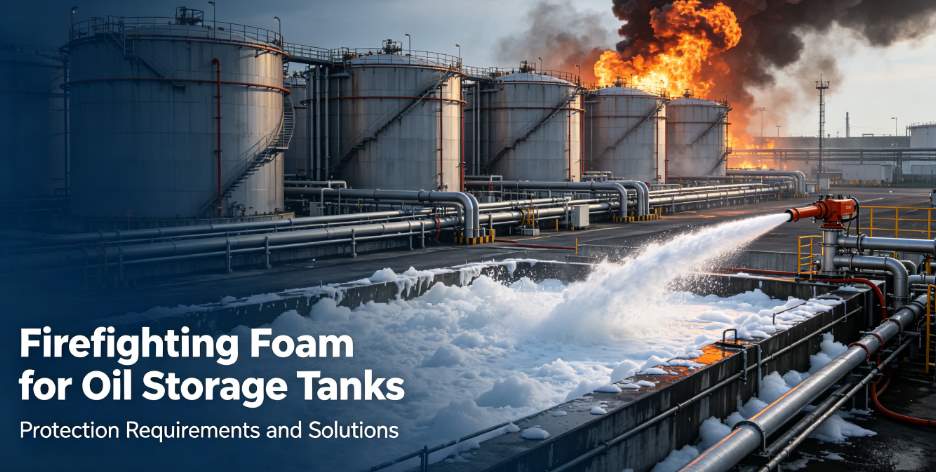
Firefighting Foam for Oil Storage Tanks: Protection Requirements and Solutions
Oil storage tanks are core infrastructure in petroleum, chemical, and energy industries, storing flammable and combustible liquid fuels that pose severe fire and explosion risks. Liquid oil spills, static electricity, high-temperature exposure, and equipment failures can easily trigger large-scale tank fires, which are characterized by fast spread, high heat radiation, and difficult extinguishment. As the most efficient dedicated fire suppression medium for oil tank fires, firefighting foam plays an irreplaceable role in isolating oxygen, cooling burning surfaces, and smothering oil fires. This article elaborates on the core protection requirements of oil storage tank fire prevention and professional firefighting foam application solutions, helping industrial enterprises standardize fire protection deployment and eliminate tank fire hazards.
1. Core Fire Protection Requirements for Oil Storage Tanks
Oil tank fire accidents have distinct industrial characteristics, so the matching fire protection systems and firefighting foam applications must comply with targeted safety standards and functional requirements. Different from conventional building fire protection, oil tank fire suppression focuses on rapid coverage, long-lasting isolation, and re-ignition prevention, with two mandatory core requirements.
1.1 Rapid Smothering and Oxygen Isolation
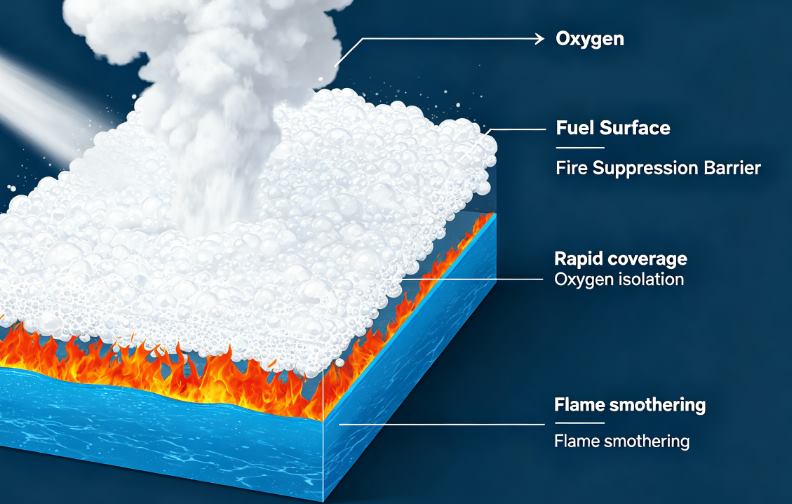
Crude oil, diesel, and gasoline stored in tanks are low-viscosity flammable liquids. Once ignited, the liquid surface will continuously volatilize combustible gas to support combustion, and conventional water spraying cannot extinguish such fires—water will even sink below the oil layer and cause boiling over, expanding the fire scope. Qualified firefighting foam can quickly spread and form a dense, continuous foam blanket on the burning oil surface. This physical isolation layer completely separates the oil fuel from external oxygen, cutting off the combustion chain reaction in the shortest time and realizing rapid fire smothering, which is the primary functional requirement for oil tank fire protection.
1.2 High Temperature Resistance and Re-ignition Prevention
Oil tank fires produce extremely high ambient temperature, and the tank wall and residual oil will retain massive heat for a long time after the open fire is extinguished, leading to extremely high re-ignition risks. Ordinary fire suppression media fail to withstand high-temperature radiation and break down easily, losing protective effects. Professional firefighting foam for oil storage tanks features excellent high-temperature stability and film-forming durability. It can adhere to the oil surface and tank wall for a long time, resist heat radiation erosion, and continuously cool the residual high-temperature area, effectively preventing secondary combustion and re-ignition, which is a key safety requirement for post-fire disposal of oil tanks.
2. Professional Firefighting Foam Solutions for Oil Storage Tanks
To meet the strict protection requirements of oil storage tanks, it is essential to select matched firefighting foam types and adopt standardized deployment solutions based on tank type, storage medium, and environmental conditions. Reasonable foam selection and system configuration directly determine the efficiency and safety of tank fire suppression.
2.1 Reasonable Selection of Firefighting Foam Types
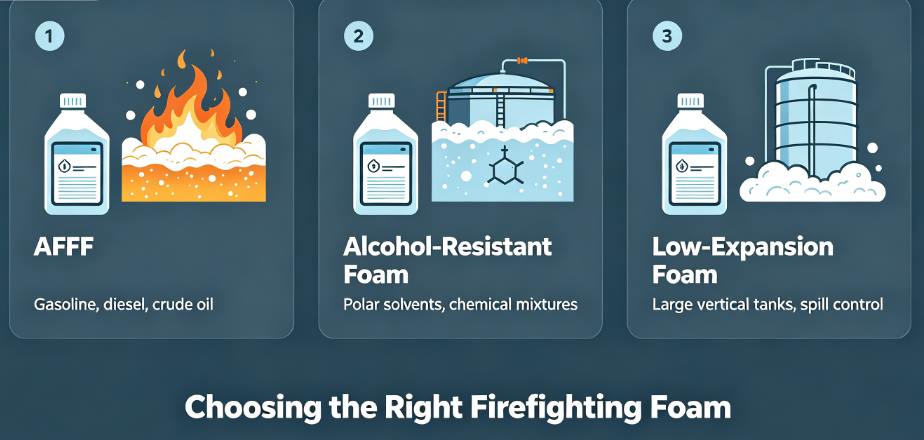
Different types of oil products correspond to different firefighting foam options to ensure optimal suppression performance. For conventional non-polar oil products such as gasoline, diesel, and crude oil stored in vertical and horizontal oil tanks, AFFF (Aqueous Film-Forming Foam) is the most widely used option. This firefighting foam can form a water-based isolation film on the oil surface while generating foam layers, achieving dual fire suppression effects of physical covering and rapid cooling with high extinguishing efficiency.
For oil tanks mixed with polar solvents or chemical oil products, alcohol-resistant firefighting foam is mandatory. Unlike ordinary foam, alcohol-resistant firefighting foam has a special polymer structure that resists the dissolution and destruction of polar liquids, maintaining the integrity of the foam blanket and stable protective performance. In addition, low-expansion firefighting foam is preferred for large-scale vertical oil storage tanks, as its dense foam structure is not easy to be blown away by wind and can fully cover large-area oil spills.
2.2 Standardized Foam System Deployment & Maintenance
High-qualityfirefighting foam needs to be matched with a complete foam suppression system to exert maximum efficacy. Oil storage tank areas should be equipped with fixed foam mixing systems, foam monitors, and pipeline delivery devices to ensure that fire fighting foam can be quickly delivered to the fire point in case of emergencies. The foam mixing ratio must strictly comply with industry standards (3% or 6% conventional ratio) to avoid insufficient film-forming performance caused by inappropriate concentration.
Regular maintenance and inspection of firefighting foam are also indispensable. Long-term storage may cause foam liquid stratification, deterioration, or performance attenuation. Enterprises need to regularly check the shelf life, liquidity, and foaming multiple of firefighting foam, replace expired foam concentrate in a timely manner, and conduct regular fire suppression drills to ensure the system can operate stably in emergency scenarios.
3. Why Specialized Firefighting Foam Is Indispensable for Oil Tank Protection
Oil storage tank fires belong to high-risk Class B fires, and general fire extinguishers and water-based fire protection measures cannot meet the safety protection standards. Professionalfirefighting foam is tailored to the combustion characteristics of oil fires, with unique advantages in rapid fire suppression, re-ignition prevention, and large-area fire control. Standardized application of firefighting foam can not only effectively reduce the probability of fire spread and explosion but also minimize property losses and safety accidents in petrochemical storage bases. For all oil storage enterprises, optimizing firefighting foam selection, deployment, and maintenance is a necessary measure to comply with industrial safety regulations and build a complete fire protection system.