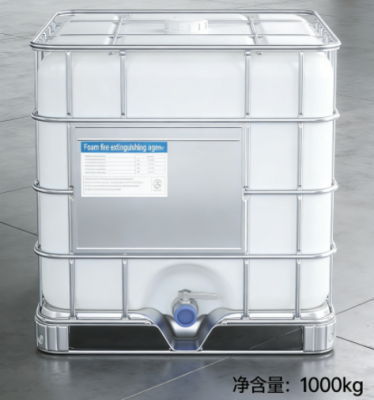
3% vs 6% Foam Concentrate: How to Select for Industrial Fire Protection
In industrial fire protection for Class B liquid fires, 3% vs 6% foam concentrate are the two most widely used specifications, covering applications such as petroleum storage tanks, chemical parks, port terminals, oil storage areas, and hazardous material warehouses. Many fire engineering contractors, corporate procurement teams, and maintenance personnel hold a common misunderstanding: they believe that 6% foam concentrate is more concentrated and therefore more effective, so they purchase it at a higher price without considering system compatibility, or even mix the two specifications arbitrarily. This may lead to imbalanced foam proportioning, failed acceptance inspections, and ineffective fire suppression, which highlights the importance of scientific foam concentrate selection.
In fact, there is no absolute superiority between 3% and 6% foam concentrates. The core differences lie in four dimensions: mixing ratio, system compatibility, storage cost, and application suitability.
1. Core Definition: What Are 3% and 6% Foam Concentrates?
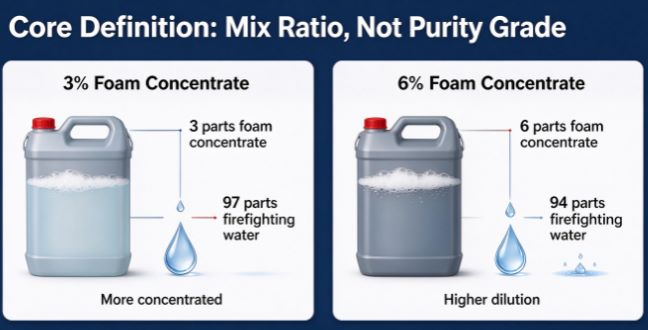
The numbers 3% and 6% do not represent purity grades. They refer to the mixing ratio of foam concentrate to firefighting water, which is a core parameter in system design and directly affects foam solution formation and fire suppression performance.
3% foam concentrate: 3 parts of foam concentrate are mixed with 97 parts of firefighting water to form a standard foam solution. It is more concentrated and has become the mainstream choice in modern industrial fire protection.
6% foam concentrate: 6 parts of foam concentrate are mixed with 94 parts of firefighting water. It is a traditional specification commonly used in older fire protection systems.
Under standard mixing conditions, there is no significant difference in fire suppression performance, foam stability, or vapor suppression capability between the two specifications. Any performance gap mainly comes from system compatibility and working conditions, which is the primary consideration of foam concentrate selection.
2. Five Core Differences Between 3% and 6% Foam Concentrates
2.1 Concentrate Consumption and Foam Expansion
Since 3% foam concentrate is more concentrated, it requires half the amount of concentrate compared to 6% foam for the same volume of water. In other words, to produce the same volume of effective foam solution, 3% foam is more economical in concentrate consumption.
At the same time, 3% foam concentrate generally achieves a higher expansion ratio, generating more effective firefighting foam and covering a larger liquid surface. In contrast, 6% foam produces relatively lower expansion under the same volume of concentrate. When comparing 3% vs 6% foam concentrate, procurement teams should fully calculate the total consumption cost.
2.2 System Compatibility
This is the most critical difference and the main reason for many acceptance failures. A foam fire extinguishing system is designed with specific proportioners, pumps, and pipelines, which must match the corresponding foam concentrate specification. Mixing different specifications is strictly prohibited.
According to GB 50151-2021, medium-expansion and high-expansion foam systems should preferably use 3% foam concentrate. Older fixed systems, some mobile foam devices, and legacy tank fire systems are often designed for 6% foam.
If 3% concentrate is used in a 6% system, the proportion may be insufficient, resulting in thin foam and rapid collapse.
If 6% concentrate is used in a 3% system, the solution may become too viscous, leading to pipeline blockage and poor foam generation.
System matching is the top rule when picking industrial fire protection foam.
2.3 Storage and Maintenance Costs
Because 3% foam concentrate is more concentrated, it requires smaller storage volume for the same fire protection capacity. This reduces tank size, warehouse space, transportation volume, and annual replacement costs, giving it a clear advantage in total cost of ownership.
6% foam concentrate requires larger storage volume and higher consumption, making it more expensive in procurement, transportation, and maintenance. It is generally selected only when the original system is designed for 6% and cannot be modified. This cost factor is often evaluated during foam concentrate selection.
2.4 Environmental Adaptability
In low-temperature conditions, 3% foam concentrate usually has better fluidity and is less prone to precipitation or freezing, making it suitable for temperate regions and outdoor installations with large temperature fluctuations.
Some 6% foam concentrates are formulated for lower-temperature environments and may be more suitable for certain fixed systems in extremely cold regions. However, modern special-grade foams—such as seawater-resistant, fluorine-free, and alcohol-resistant foams—are more commonly available in 3% versions. When analyzing 3% vs 6% foam concentrate, site environmental conditions cannot be ignored.
2.5 Industry Application Trends
The current industrial fire protection market is clearly trending toward 3% foam concentrate as the mainstream specification. For new chemical parks, oil depots, port terminals, and power plant fuel areas, 3% foam is usually the first choice.
6% foam concentrate is now mainly used for legacy system maintenance and replacement, especially in older facilities where the proportioner and piping design cannot be changed. Many project designers now prioritize industrial fire protection foam with flexible storage and low long-term consumption.
3. Industrial Selection Guide: When to Choose 3% or 6%?
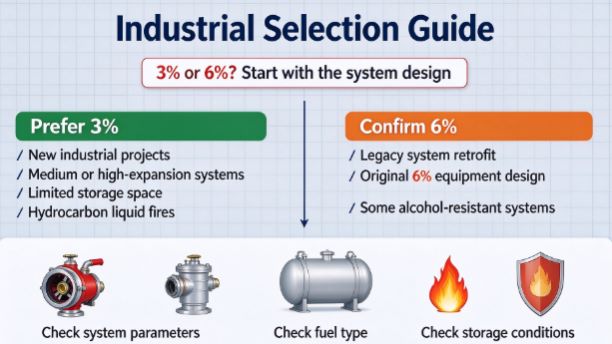
3.1 Scenarios Where 3% Foam Concentrate Is Preferred
New industrial projects, including chemical plants, oil depots, tank farms, port terminals, and power plant fuel areas
Fixed medium-expansion and high-expansion foam systems
Projects with limited storage space or fixed tank volume
Fire protection for conventional hydrocarbon liquids such as gasoline, diesel, kerosene, and crude oil
Projects seeking long-term cost efficiency and lower maintenance
3.2 Scenarios Where 6% Foam Concentrate May Be Required
Retrofit of older systems originally designed for 6% foam
Some legacy alcohol-resistant foam systems
Specific low-temperature fixed systems designed for 6% concentrate
4. Three Critical Selection Pitfalls
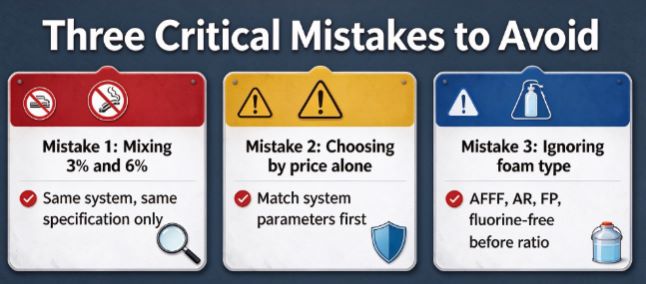
4.1 Never Mix 3% and 6% Foam Concentrates
Mixing different specifications in the same system will disrupt the proportioning balance, reduce foam stability, and may cause fire suppression failure. It will also result in failure of fire acceptance inspection.
4.2 Never Choose Solely Based on Price
A higher price does not mean better performance. The key is whether the specification matches the system design parameters. Users should avoid blindly purchasing 6% foam just because it appears more concentrated.
4.3 Never Ignore Foam Type
3% and 6% are proportioning specifications, not foam categories. Before selecting a ratio, users must first determine the required foam type, such as AFFF, alcohol-resistant, fluoroprotein, fluorine-free, or seawater-resistant foam.
The difference between 3% vs 6% foam concentrate lies mainly in mixing ratio, system compatibility, storage cost, and application suitability, not in inherent fire suppression performance. For new industrial projects, 3% foam concentrate is generally the preferred choice because it balances compliance, cost efficiency, and stability. For older facilities, 6% foam concentrate should be selected according to the original system design.
The most important rule is simple: never replace or mix foam concentrate specifications without verifying the system design. Proper foam concentrate selection and standardized storage can help industrial fire protection foam systems deliver reliable fire protection for industrial facilities.