Seawater-Resistant AFFF Concentrate | Offshore & Terminal Fire Protection
Offshore platforms, oil loading terminals and coastal tank farms sit in the most punishing environment any fire-protection system can face — constant salt spray, high humidity, space constraints and limited access to fresh water. Standard fire-fighting agents often fail precisely when they are needed most. Seawater-Resistant AFFF Concentrate is engineered to close that gap, delivering stable fire suppression even when proportioned directly with seawater. This guide explains why it matters, how it works, where it applies and how to choose it correctly.
1. Why Offshore Environments Break Standard Foam Agents
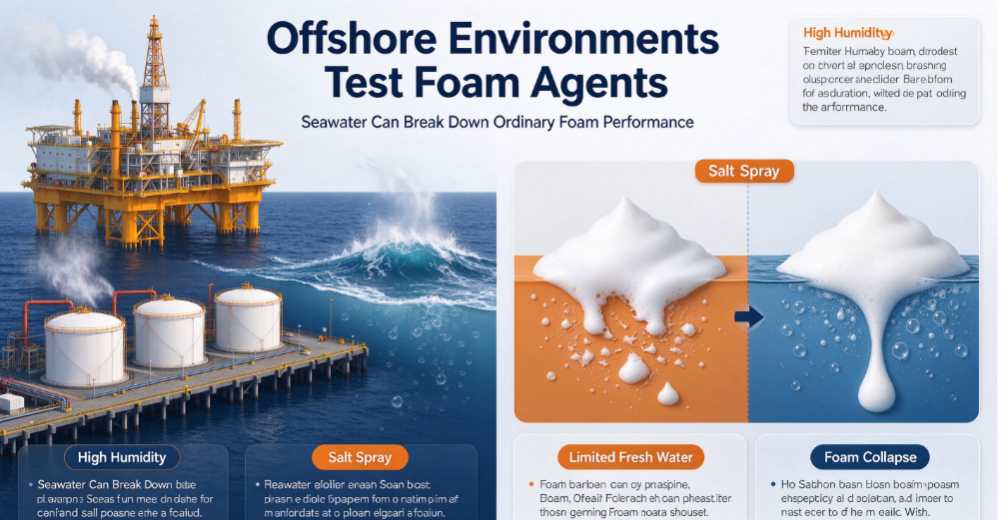
Most conventional fire-fighting foam requires fresh water for accurate proportioning. Seawater carries chloride ions, dissolved salts and suspended solids that degrade the surfactants inside ordinary formulations. When mixed with seawater, a standard Foam Concentrate collapses quickly, loses its spreading ability and cannot build a continuous vapor-sealing film over burning hydrocarbon fuel.
That failure is unacceptable on offshore platforms, where freshwater reserves are often limited during an emergency. This is the core reason operators shift to Seawater-Resistant AFFF Concentrate. Its surfactant system is reformulated to tolerate salt, so the foam keeps its surface activity after seawater mixing and still forms a tight, durable foam blanket that blocks flammable vapors and cuts the oxygen supply.
2. How Seawater-Resistant AFFF Concentrate Maintains Reliable Performance
The chemistry behind this Foam Concentrate is redesigned for salt tolerance. Salt-resistant polymer and film-forming additives preserve proper viscosity and bubble elasticity after the foam solution is blended with seawater. When discharged through offshore foam monitors or sprinkler nozzles, the foam spreads rapidly across crude oil, diesel and gasoline pools.
Seawater-Resistant AFFF Concentrate follows standard 3% or 6% proportioning ratios, so operators can connect the proportioner directly to a seawater pipeline. After mixing, the foam forms a stable aqueous film on the fuel surface. That film is the decisive factor in successful fire extinguishing and in preventing flashback — a constant threat in the dense, equipment-packed layout of offshore platforms. Many older systems still depend on freshwater backup tanks; switching to a seawater-tolerant Foam Concentrate simplifies the whole system layout and frees valuable deck space.
3. Where This Foam Concentrate Delivers the Most Value
Seawater-Resistant AFFF Concentrate is purpose-built for high-risk coastal and offshore assets. Typical deployment sites include fixed offshore platform production decks, floating production storage and offloading units (FPSO), oil loading jetties, bulk liquid terminals and coastal tank farms. These locations expose fire equipment and agents to salt corrosion year-round.
Because this Foam Concentrate remains stable during long-term storage in coastal equipment rooms, terminal safety teams can rely on it across both fixed deluge systems and portable foam equipment. Its anti-salt property also reduces maintenance work — there is no need to flush the system frequently to remove mineral deposits that would damage ordinary foam. For high-value marine facilities, dependable performance under emergency conditions is the top priority, and seawater-tolerant foam delivers it.
4. Selection and Storage Guidelines for Marine-Grade Seawater-Resistant AFFF Concentrate
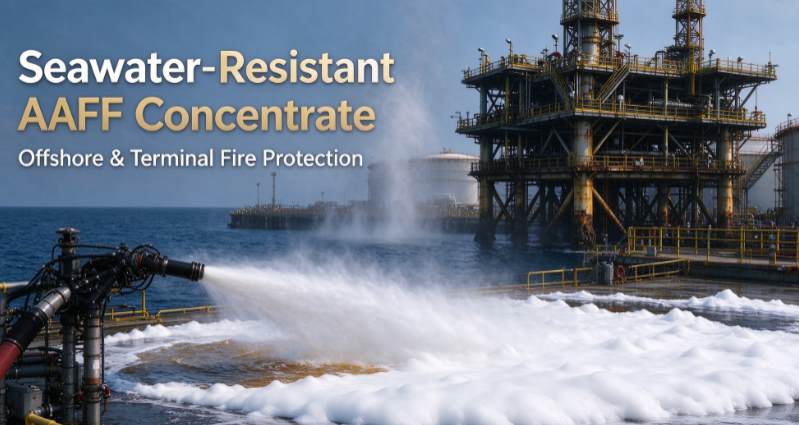
When purchasing Seawater-Resistant AFFF Concentrate, verify third-party marine fire certifications and seawater-compatibility test reports. Not every product labeled "marine suitable" performs consistently with high-salinity seawater, so confirm the agent meets offshore platform standards before integrating it into the fire-protection design.
Storage directly affects service life. This Foam Concentrate should be kept in sealed tanks inside ventilated, temperature-controlled rooms, away from direct salt spray. Never mix different foam types, because cross-contamination damages the specialized formula. Routine sampling inspection helps you detect stratification or sediment early, keeping the agent in good condition so the system can activate instantly when an oil fire breaks out.
For offshore platforms and marine terminals exposed to constant saltwater, choosing the right agent is critical. Seawater-Resistant AFFF Concentrate provides a field-proven solution where standard foam fails. This specially formulated Foam Concentrate allows direct proportioning with seawater, simplifies system design and maintains dependable fire suppression for hydrocarbon liquid fires. If you manage marine fire-protection assets, seawater-resistant foam is a sound investment to lower operational risk and meet strict offshore safety requirements.