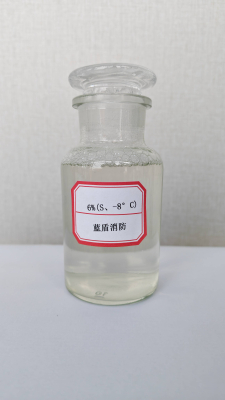
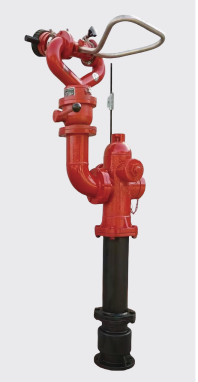
How AFFF Foam Creates a Fire Suppression Barrier
A fuel fire can be knocked down in under sixty seconds, yet the same pool can re-ignite twenty minutes later — or never, depending on one invisible factor: whether a continuous barrier was actually established on the liquid surface. That barrier is the entire product of AFFF foam. Understanding how AFFF foam creates a fire suppression barrier means understanding surface tension, drainage physics, and application hydraulics, not just "spraying white stuff on a burning tank." This article breaks the mechanism down into measurable stages and shows where firefighting foam systems succeed or silently fail.
1. The Barrier Is Physical Before It Is Chemical
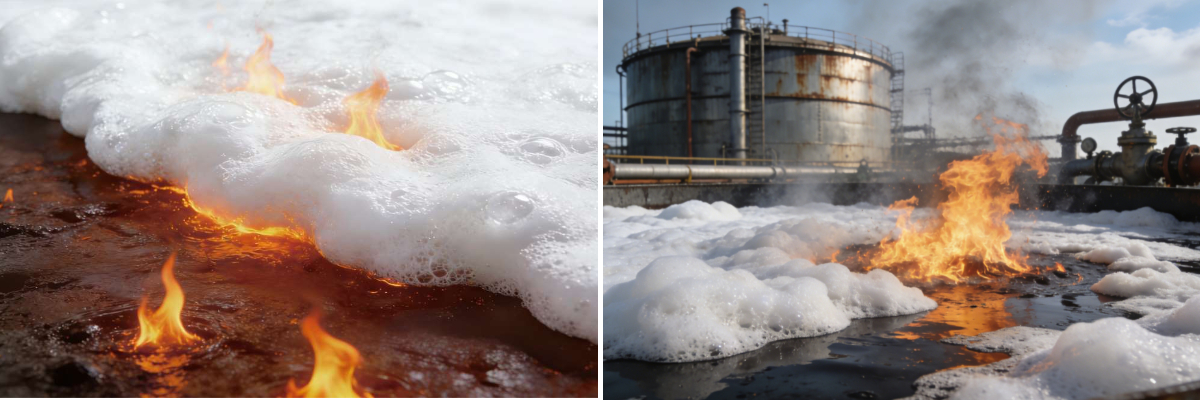
AFFF (aqueous film-forming foam) works because its fluorochemical surfactant package pushes the surface tension of the water-based solution down to roughly 3 mN/m or lower, well below the 20–30 mN/m range typical of hydrocarbon fuels such as gasoline, diesel, kerosene and crude oil.
That disparity is the whole trick. Because the solution wets the fuel better than the fuel wets itself, the water phase spreads spontaneously across the liquid surface rather than sitting as isolated droplets. AFFF foam creates a thin continuous aqueous film within seconds of contact, and that film — not the visible bubbles — is what first seals the fuel from the air above it.
A conventional protein or synthetic firefighting foam without film-forming capability must rely on bubble geometry alone, which is why it is far less forgiving of rough application or windy conditions.
2. How AFFF Foam Creates the Barrier in Three Sequential Stages
Stage 1 — Film spreading (seconds)
On contact with the fuel surface, the aqueous film spreads radially outward, closing gaps between individual bubble clusters. This happens faster than the foam blanket can physically build up, which is why knockdown speed is dominated by film behaviour.
Stage 2 — Blanket accumulation (tens of seconds to minutes)
Expanded bubbles stack on top of the film, forming an insulating layer of defined thickness. The film stops vapour, the blanket stops heat, and together they begin to cool the surface.
Stage 3 — Sustained suppression (minutes to hours)
The barrier persists only while its water content lasts. Drainage rate, bubble stability and resistance to burnback decide whether the fire stays out. This is the stage where most firefighting foam deployments in industrial settings are ultimately judged.
The three protection mechanisms running simultaneously
Vapour sealing: the film physically separates fuel vapour from the ignition source.
Thermal insulation: the bubble layer limits radiative and convective heat feedback to the liquid.
Cooling: water draining from the foam absorbs heat from the fuel surface, reducing vapour generation at the source.
AFFF foam creates a barrier only when all three operate at once; drop any one and the fire returns.
3. The Measurable Anatomy of a Barrier
Expansion ratio
Low-expansion foam (usually 5:1 to 20:1) is specified for tank and bund fires because it produces a dense, heavy blanket that withstands wind. Medium and high expansion trade thickness and mobility for weight, and a thin blanket of firefighting foam will not resist a breeze.
25% drainage time
This is the time for a quarter of the solution's water to drain out. A longer drainage time means a thicker, longer-lived protective barrier — but also a heavier foam that is harder to throw across a large tank surface.
Burnback resistance
Burnback testing measures how long the barrier holds when a flame is re-introduced to its edge. It is the single most honest indicator of whether AFFF foam creates a barrier that survives after the attack line is shut down.
4. Where Real-World Barriers Collapse
Subsurface and plunging application. Injecting foam below the liquid line destroys bubbles before they reach the surface; no film forms, only froth.
Excessive application rate on the wrong fuel depth. Fuel-in-depth tank fires require controlled, gentle surface delivery, not high-pressure streams that dig into the product.
Wind and hot surfaces. Above roughly 5 m/s, foam blankets drift and thin; hot tank shells and bund walls pre-drain the water phase before the barrier consolidates.
Water contamination and dilution. Hard water, seawater salinity beyond the product's tested range, and residual cleaning chemicals can collapse bubble structure.
Proportioning drift. This is the most common silent failure — see below.
5. System Design Decides Whether the Barrier Forms at All
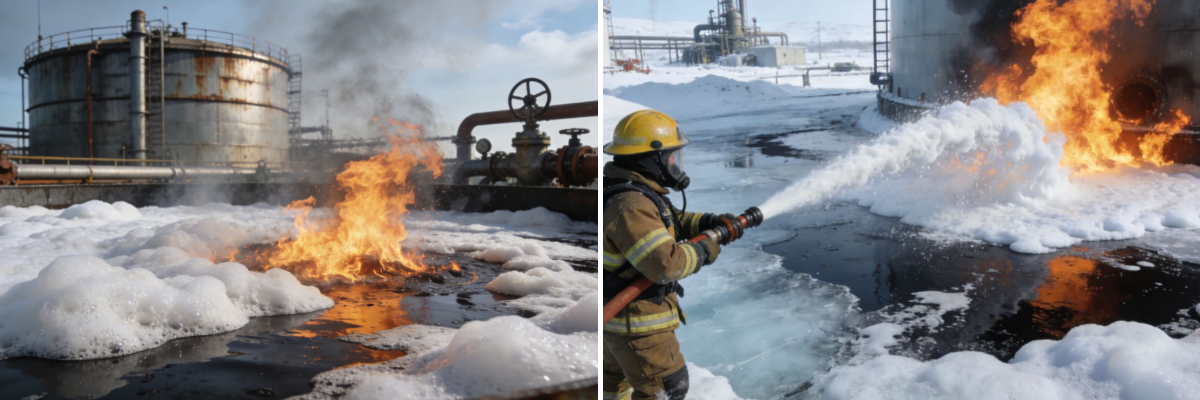
AFFF foam creates the barrier in the nozzle, not in the tank. Three design variables determine success:
Proportioning accuracy
Most fixed systems specify 3% or 6% induction. A proportioner running a few percent out of tolerance produces either weak, watery foam or over-concentrated, viscous foam; in both cases the film fails to spread evenly.
Application rate matched to fuel and surface
Design rates are commonly 4–6 L/min/m² for hydrocarbon spills and bund fires, with higher values for high-flashpoint products and for sub-surface injection schemes. Under-designed rates cannot build sufficient blanket before thermal degradation begins.
Nozzle type and aspiration quality
Air-aspirating branch pipes and foam makers generate the correct bubble structure; non-aspirating nozzles deliver wet, unstable firefighting foam that drains almost immediately.
6. The Limits of the Barrier and the Fluorine-Free Shift
AFFF foam creates an effective barrier on hydrocarbons — and almost none on polar solvents. Methanol, ethanol, acetone and acetate fires dissolve the aqueous film on contact, which is why alcohol-resistant grades add a polymeric membrane that isolates the foam from the solvent.
The other limit is regulatory. Fluorine-based chemistry behind AFFF is under sustained restriction across the EU, North America and multiple export markets, and newer standards such as GB 15308-2025 tighten performance and environmental requirements together. Fluorine-free alternatives now achieve credible Class B performance, but they generally need higher application rates, different hardware and longer extinguishment times. Buyers comparing firefighting foam options should read burnback and drainage data, not marketing claims.
Engineering the Barrier, Not Buying the Liquid
AFFF foam creates a fire suppression barrier through a precise sequence: a low-surface-tension film spreads across the fuel, a bubble blanket accumulates above it, and a water reservoir sustains both until the fuel is cool enough to stop producing vapour. Every link in that chain is a design decision — fuel type, expansion ratio, proportioning accuracy, application rate, nozzle selection, water quality, storage condition.
Treat the concentrate as one component of a barrier system, verify the extinguishment data against the specific fuel and the specific standard, and the barrier will hold. Treat it as a commodity purchased by price alone, and the barrier will exist only on the datasheet.